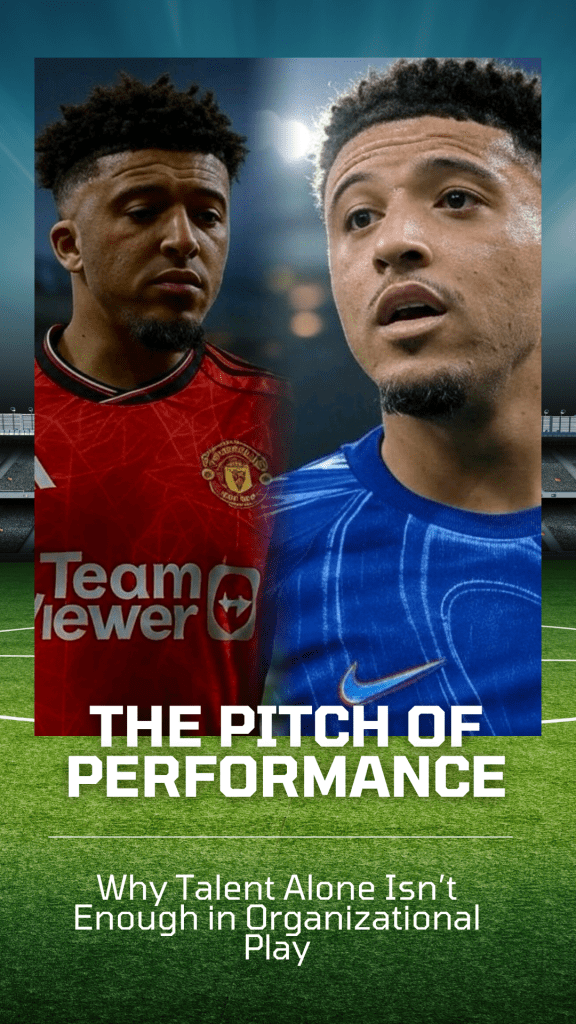
In the world of football (or soccer, as it’s called in some parts of the world), we often see players who shine brightly in one club only to dim when transferred to another. This phenomenon isn’t just about the player; it’s largely about the environment they’re placed in.
Similarly, within organizations, the surrounding culture, leadership, and infrastructure can either elevate or hinder the performance of even the most talented individuals. Let’s explore this through the lens of football.
The Case of Jadon Sancho
At the risk of laughing at my own favorite club, Manchester United, I’ll share the story of Jadon Sancho.
Sancho was a star at Dortmund, where the club culture allowed for creativity and freedom on the pitch. Upon moving to Manchester United, he encountered a different team dynamic. Under leadership of Ole Gunnar Solskjaer and later Ralf Rangnick, he faced period of instability. The transition has been challenging, with his performance fall below his Dortmund days. Whereas it is often cited as due to the lack of a cohesive team strategy and a supportive environment.
Surely, nobody doubt Jadon’s talent, which just 2 years back, was illuminating the Bundes Liga. But then, talent alone is not enough. Sancho thrived in an environment where risk-taking is encouraged, creativity is celebrated, and mistakes are seen as learning opportunities. When he was transferred to Manchester United, big money fees were involved, and expectation of him went through the roof. At club with Manchester United stature, with biggest passionate fan base in the world, he is in spot light. Every mistakes and under-par performance were dealt in microscope. There seems no grace period. He had to cope with adjusting to the new coach, new team members, new tactics and most importantly, new culture, while performing at the same time.
Just like in organizations, culture sets the tone for how work is done, how innovation is approached, and how failure is handled. A culture that doesn’t align with an individual’s work style or values can lead to disengagement or underperformance. Worse in the case of Sancho, the underperformance became the news headline in the morning. Which affected his confidence. And turned into vicious circle where performance dipped even further.
This is where great leadership should intervene. It sets the right environment for talent to flourish.
Leadership: The Coach’s Influence
In football, the coach’s philosophy and leadership style play pivotal roles in a player’s development and performance. A coach who understands how to harness a player’s strengths, adapt strategies to fit their style, and provide constructive feedback can turn a good player into a great one. Conversely, a coach with a one-size-fits-all approach or poor man-management skills can leave even the most skilled player floundering.
Similarly, in corporate settings, leadership can make or break an employee’s performance. If leaders fail to recognize and leverage the unique talents of their team members, if they micromanage, or if they do not provide clear, supportive feedback, even the most competent employees may falter. For example, a visionary employee might shine under a leader who encourages autonomy but could be demotivated by a micromanager who insists on controlling every aspect of their work.
Infrastructure: The Pitch and Facilities
Imagine a football player moving from a club with state-of-the-art facilities, excellent training grounds, and top-notch medical support to one where even the pitch is poorly maintained. The player’s performance might suffer due to inadequate training facilities, lack of proper recovery environments, or even poor equipment.
In organizations, infrastructure refers not just to physical spaces but also to tools, technology, and processes. An employee accustomed to working with cutting-edge technology and efficient systems might find themselves at a disadvantage in an organization that lags in tech adoption or has inefficient operational processes. This mismatch can lead to frustration, reduced productivity, and ultimately, poor performance.
The Transfer Window: Adapting to New Environments
The analogy of a football player’s transfer can teach us much about adaptability. When a player moves clubs, they must adapt to new tactics, teammates, and expectations. Sometimes, they need time to adjust, and sometimes, the fit might never be right. In organizations, when someone with exceptional talent is placed in an environment that doesn’t match their skills or work ethos, it’s crucial for both the individual and the organization to recognize the mismatch. Training, mentorship, or even a role change might be necessary to realign the talent with the environment.
Conclusion: Synergizing Talent with Environment
The lesson here is clear: talent needs the right environment to flourish. Much like a football player needs the right club culture, coaching, and facilities to perform at their best, employees require an organizational culture that resonates with their values, leaders who know how to bring out their best, and infrastructure that supports their work.
Organizations should strive to assess not just the skills of potential hires but also how well these skills can mesh with their existing environment. Similarly, individuals should consider organizational fit as much as job role when seeking new opportunities. Just as in football, where a transfer can either make or break a career, in the corporate world, the right or wrong fit can significantly influence one’s success and satisfaction.
Back to Jadon Sancho’s story. He is currently on loan to Chelsea. Where it seems he rediscovered his form. Enzo Maresca, the manager of Chelsea Football Club, has praised Jadon Sancho’s performance and consistency. Maresca has said that Sancho is doing well and that he’s surprised by his consistency. Whatever Chelsea or Maresca do, it seems the environment there is more fit to Sancho than in Manchester United.
In the end, it’s not just about having the talent; it’s about ensuring that talent is in an environment where it can truly shine.